Oct 10, 2026Shore Power
Shore Power vs Auxiliary Engines: Fuel and CO2 Cost Comparison
Shore power vs running auxiliary engines at berth: how to calculate fuel and CO2 savings, what equipment you need to switch, and the AFIR 2030 compliance driver.
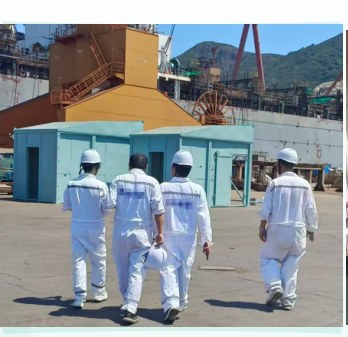
Walk along any quay at night and you will hear it: auxiliary engines idling at berth to power lighting, HVAC, reefer containers and cargo gear. Shore power — also known as cold ironing — replaces that onboard generation with grid electricity delivered through a standardized shore connection. This article shows how to run the cost comparison with your own figures, where shore power wins beyond the fuel bill, and what equipment a switch requires.
How to Calculate Your Berthing Fuel Cost
A first-order comparison needs no consultant — only your own operating data. Start with the fuel side:
Annual berthing fuel cost = berthing hours per year × auxiliary engine consumption at berth (L/h) × fuel price per liter
A typical auxiliary diesel at berth burns tens of liters per hour, but use your logged figure rather than a rule of thumb. Then price the same hours on shore power:
Annual shore power cost ≈ average at-berth load (kW) × berthing hours per year × shore electricity tariff (per kWh)
The difference between the two totals is the annual operating gap for your trade. Because fuel prices, electricity tariffs and shore power fees vary by port, run the calculation per route, not per fleet.
Where Shore Power Wins
Emissions at the berth. Auxiliary engines release CO2, NOx, SOx and particulates directly at the quay. Shore power shifts generation to the grid — with a cleaner grid mix, at-berth CO2 falls, and emissions at the ship's stack stop entirely.
Noise and vibration. Silencing the engine room at berth improves crew rest and removes a constant friction point with port neighbors.
Maintenance. Every berthing hour on shore power is an hour the auxiliary engines do not accumulate — extending the interval between overhauls and cutting lube oil, spares and survey workload.
Carbon intensity. Under the IMO CII regime the required reduction factor reaches 11% in 2026 and tightens by a further 2 percentage points each year. Replacing at-berth fuel burn with grid electricity reduces the fuel consumption your rating is calculated from.
The Compliance Driver
From 1 January 2030, the EU Alternative Fuels Infrastructure Regulation (AFIR, Regulation 2023/1804) requires TEN-T core maritime ports to provide shore power to container and passenger ships of 5,000 GT and above making at least 50 calls per year, covering 90% of the energy demand of those calls. On the same date, FuelEU Maritime obliges those vessels at berth to use shore power or zero-emission technology, with the scope expanding in 2035.
The fleet is ahead of the rule: about 3,940 ships worldwide already have shore power reception capability — 14.5% of global tonnage (Clarksons, January 2026). For shipowners on EU trades, reception capability is moving from a differentiator to a condition of efficient port calls.
What You Need to Switch
Ship side:
Shore power connection box — LV (63–350 A) for tugs, ferries and inland tonnage, or HV (6.6–15 kV) for larger vessels; IP66 enclosures for exposed decks.
Cable reel — on HV systems, a reel rated 6.6/11/15/25 kV and up to 500 A to handle the ship-to-shore loop safely.
Plugs & sockets — dimensionally compatible with international shore power interfaces, so new units directly replace aging imported parts.
Protection and control — circuit breakers, synchronization, interlocks and ship-shore communication.
Shore side: transformer, shore-side connection cabinets and quay sockets matched to the same interface standard.
Sourcing ship-side and shore-side as one turnkey shore power system removes the interface risk between the two scopes, and each shore power connection box, reel and plug is backed by type approval from CCS, ABS, LR, DNV and BV.
Typical Payback Logic
Payback follows one line: equipment investment ÷ annual savings. Two variables dominate the result — the fuel-to-electricity price spread in the ports you call, and your annual berthing hours. High-utilization vessels on fixed schedules, such as ferries and liner container ships, sit at the favorable end of both variables and recover fastest. Occasional callers recover more slowly, and may still justify the investment on compliance and carbon-intensity grounds. We do not publish a universal payback figure because none honestly exists — the formulas above, filled with your route data, give the answer for your operation.
FAQ
Is shore power always cheaper than running auxiliary engines?
Not universally. It depends on the fuel price versus the shore electricity tariff at each port. Run the two formulas above with your numbers; in many ports the balance favors shore power, but verify locally before committing.
What does "cold ironing" mean?
It is the traditional maritime term for shore power — shutting down all onboard engines and running the ship on grid electricity while at berth.
How long does shore power equipment take to deliver?
Standard items — connection boxes, cable reels, plugs and sockets — ship in 15–25 working days with no MOQ. Recent deliveries include projects in Russia, Singapore and Bangladesh.
Does shore power help with CII and EU regulations?
At-berth grid electricity replaces onboard fuel consumption, lowering the basis of your CII rating at a time when the required reduction factor reaches 11% in 2026 and tightens by 2 percentage points per year. From 2030, FuelEU Maritime and AFIR make shore power at berth a requirement for the vessels in scope.
Planning a shore power project? Request a Quote — engineers reply within 24 hours with type approval documents.